


by Albert Einstein · Newton Compton Editori · tapa blanda · ISBN 9788879830003

VAT included




Hamelyn quality guarantee · checked and verified, or your money back
«Teoria dei quanti di luce» is the physics essay by Albert Einstein, published by Newton Compton Editori in paperback (92 pages, in Italian).
An early work by Einstein, from 1905, in which he argues that low-density radiation behaves, from a thermodynamic standpoint, as if it were made up of independent energy quanta, in contrast to the classical wave theory of light, and which would pave the way for a revolution in physical ideas.
Complete edition published in 1992, with introduction and editing by Armin Hermann, in the Centopaginemillelire series (no. 31) of Tascabili Economici Newton.
For readers interested in quantum physics and the history of science, particularly the origin of Einstein's ideas about light.


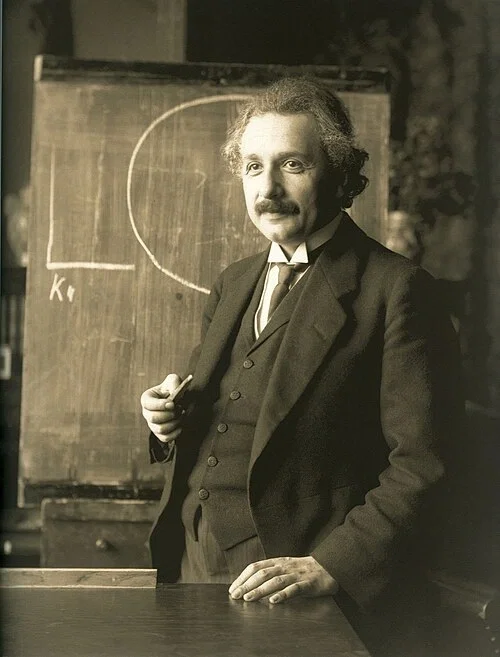
Albert Einstein was a German-born theoretical physicist best known for developing the known theory of relativity. Einstein also made important contributions to quantum theory. His mass–energy equivalence formula E = mc2, which arises from special relativity, has been called "the world's most famous equation". He received the 1921 Nobel Prize in Physics for "his services to theoretical physics, and especially for his discovery of the law of the photoelectric effect".


Tapa blanda


